- Call for help: +91-8770828485
- Mail to us: threephase415v@gmail.com
- Open time: Mon to Sat (9.30 Am - 6.30 Pm)
- Call for help: +91-8770828485
- Mail to us: threephase415v@gmail.com
- Open time: Mon to Sat (9.30 Am - 6.30 Pm)
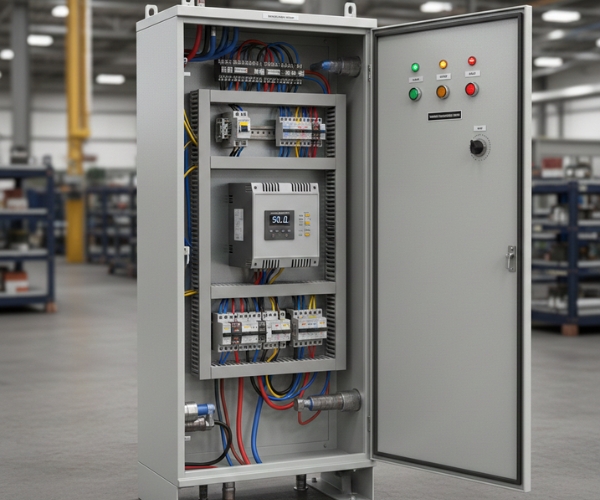
A SCADA (Supervisory Control and Data Acquisition) Control Panel is a complex industrial control panel to monitors and control processes of a central position and automate processes. It gathers real-time information about field gadgets, e.g. sensors, PLCs, RTUs, and so on, to help operators to monitor operations, examine their performance, and implement a timely action. SCADA Control Panels are commonly utilized in such industries as power, water treatment, manufacturing, oil and gas, and infrastructure.
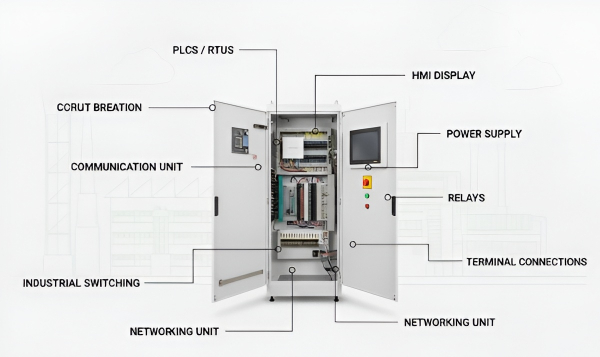
Most SCADA control panels are made up of PLCs or RTUs, HMI displays, a communication unit, a power supply, industrial switching, relays, circuit breakers, terminal connections, and a networking unit. These elements combine to collect and process data, relay it to the control system, and process control commands correctly and dependably.
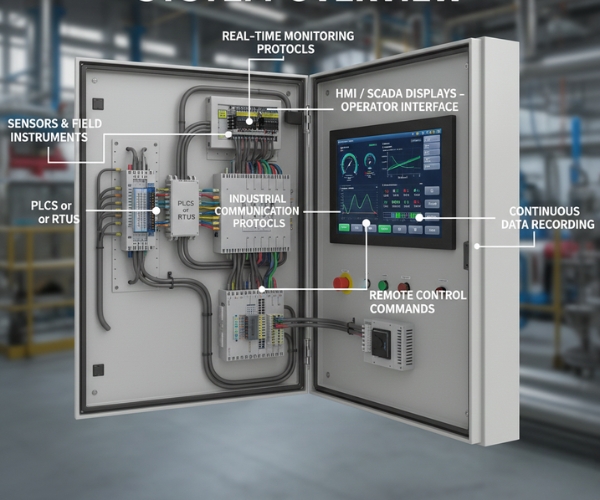
SCADA Control Panel has sensors and field instruments, which are installed throughout the plant and provide it with input. PLCs or RTUs process these signals and pass it on to the SCADA software using industrial communication protocols.
Operators control the performance of the systems by watching HMI or SCADA displays, and also send out control orders when necessary. The panel records continuously, raises an alarm whenever there are abnormal conditions and allows remote operating thus efficient and safe control of the processes.
Allows operators to monitor several processes and sites using one control interface.
Gathers and presents real-time operational information to make correct decisions.
Presents real-time alerts to faults, deviations or any emergency.
Allows one to track and control processes remotely.
Interoperable with other PLCs, RTUs, and automation of industries.
Enables the expansion of the system and future upgrade to the automation without redesign.
Automation and real-time monitoring reduce human intervention and communication latency.
An early fault detection method is employed to prevent device damage and system downtime.
Thanks to the advanced data tracking and trend analysis, it helps you to operate more safely.
This is where full control can save manpower and energy.
Constant surveillance is done to promote safe operation and adherence to regulations.
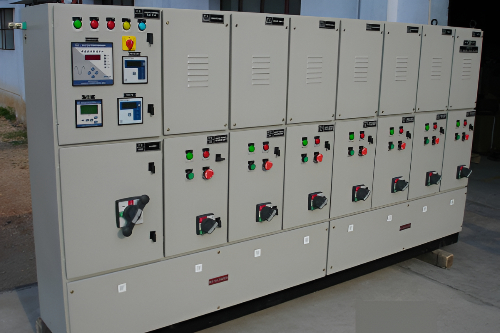
An effective SCADA control panel supplier and manufacturer in India is concerned with quality automation hardware, safe communication and strong panel design. A qualified manufacturer will provide panels that will aid in the crucial monitoring of the process, durability, and smooth integration with other industrial systems.
Three Phase Electric Company designs and supplies SCADA control panels that are designed with accuracy, reliability and scalability. They have customized their panels to suit certain process needs and automation sophistication. The company is providing SCADA control panel solutions with high-quality components, rigorous testing protocols and strong technical support, which help them to improve control in their processes, operational efficiency and long-term system performance.
WhatsApp us
